

From December 25th to 26th, the sixth session of the Foreign Literature Research Salon of the School of Foreign Languages at Shanghai Jiao Tong University, titled "Foreign Literature Research and the Construction of an Independent Knowledge System", was successfully held. This event consisted of two parts: an academic report and a roundtable discussion. Professor Zhang Jian from the School of English Studies at Beijing Foreign Studies University was invited as the keynote speaker. Professor Shang Biwu, the Distinguished Professor and Dean of the School of Foreign Languages at Shanghai Jiao Tong University, Professor Yang Feng, a professor and doctoral supervisor at the School of Foreign Languages at Shanghai Jiao Tong University, Distinguished Professor Liu Jianjun, and doctoral student representatives Li Meixuan and Wang Zhen participated in the dialogue. The event was hosted by Dean Shang Biwu.

Dean Shang Biwu delivered the opening remarks for this event. He pointed out that Professor Zhang Jian's visit not only provided valuable academic demonstrations to the SFL faculty and students, but also promoted in-depth discussions on the construction of an independent knowledge discourse system for foreign literature. He expected that this salon activity could further stimulate the exchange and collision of cutting-edge academic ideas. 
In the academic report session, Professor Zhang Jian delivered a presentation titled "Digital Humanities and Quantitative Research Paradigms in Foreign Literature", offering a profound interpretation of the paradigm shift brought about by digital humanities in literary studies. He traced the academic lineage from John Burrows' "from computing to criticism" to Franco Moretti's "distant reading" theory, emphasizing that the introduction of computational methods is not intended to replace traditional close reading but to open up a new knowledge production model based on empirical evidence and induction. Professor Zhang Jian stressed that when dealing with vast amounts of text and complex modernist works, quantitative analysis provides an empirical reference beyond impressionistic judgments, but the attribution of meaning always depends on the researcher's humanistic literacy. He believes that this interdisciplinary approach expands the cognitive boundaries of the complexity and historicity of literature and represents an important knowledge form for the future integration of empirical science and humanistic interpretation.

In the comment session, Professor Yang Feng expressed his sincere gratitude to Professor Zhang Jian for his presentation. He pointed out that Professor Zhang Jian, taking digital humanities and artificial intelligence as the entry point, systematically outlined the evolution path of foreign literature research from traditional close reading to distant reading and AI criticism, thus providing crucial insights for the transformation of research paradigms in foreign literature. He noted that quantitative research and digital humanities methods are profoundly reshaping the development landscape of the foreign literature discipline. For young scholars, making full use of their mathematical and scientific backgrounds and combining humanistic concerns with systematic and logical research methods may become an important development direction for foreign literature research in the future.

On the 26th, during the salon dialogue session, Zhang Jian, drawing on his own academic research experience, delivered an in-depth discussion on the core topic of "Foreign Literature Studies and the Construction of an Independent Knowledge System".

Zhang Jian pointed out that foreign literature studies are undergoing a transformation from a single center to a decentralized and regionalized approach. Chinese scholars should shift from early stage of simple introduction to a comparative perspective with a sense of subjectivity. Taking the writings about the War of Resistance against Japanese Aggression by Western writers such as Empson and Auden as examples, Zhang Jian vividly demonstrated how the method of "mutual verification of literature and history" can restore pure semantic analysis to the specific historical context. He emphasized that an independent knowledge system means re-measuring and redefining the world literary landscape from the Chinese position, perspective and experience. For instance, by exploring the testimonies of Western classic writers on China's War of Resistance, the Eurocentric bias in the Western narrative of World War II can be corrected. 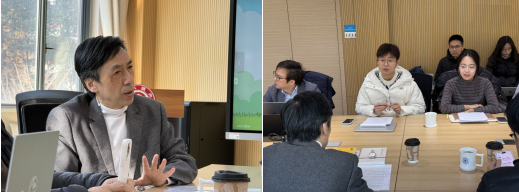
Professor Liu Jianjun delivered a concluding comment on this salon. He highly praised Professor Zhang Jian's academic approach, believing that his research demonstrated how to maintain the subjectivity of Chinese scholars while conducting in-depth studies of foreign cultures. Professor Liu Jianjun particularly emphasized the importance of social historical analysis, pointing out that no matter how theoretical paradigms change, only by adhering to the mutual verification of literature and history and grounding the analysis of aesthetic forms in solid historical soil can academic research avoid becoming rootless theoretical performance.

The foreign literature research salon event held by Shanghai Jiao Tong University was a complete success.