

The Linguistics Lunch Seminar of the School of Foreign Languages, Shanghai Jiao Tong University, for the fall semester of 2025 concluded successfully on December 25th. As an important academic exchange platform of the school, the Linguistics Lunch Seminar successfully held 13 splendid academic reports this semester, covering multiple research fields of linguistics such as theoretical linguistics, computational linguistics, psycholinguistics, and applied linguistics. These rich and in-depth reports not only demonstrated the broad vision of the teachers and students of the School of Foreign Languages of Jiao Tong University in linguistics research, but also highlighted the school's profound academic accumulation and continuous research vitality in this field.

1. Theoretical Linguistics
Qin Yang, a student of theoretical linguistics, systematically investigated the diversity of Chinese roots and found that Chinese roots exhibit significant non-homogeneous features in terms of agglutination, position, phonetics and semantics. This findings holds has important theoretical value for both intra-linguistic and cross-linguistic studies on root variation.

2. Psycholinguistics
Student Huang Yuqing and Associate Professor Li Fei used ERP technology and found that when native Chinese speakers learned new words in German and Korean, the P600 component presented a U-shaped learning curve. This suggests that it might serve as a neural marker for adult foreign language vocabulary acquisition ability.

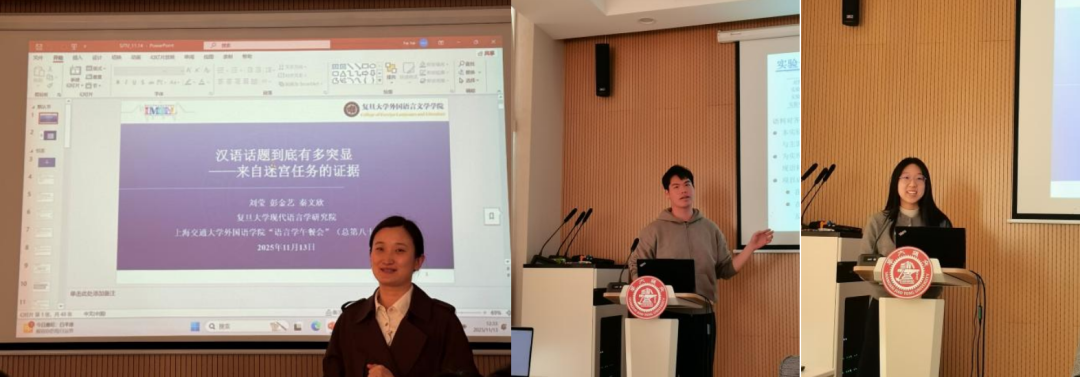
Students Peng Jinyi and Qin Wenxin, along with Associate Researcher Liu Ying, focused on the processing mechanism of Chinese topic structure. Through three maze task experiments, their research revealed that the processing of Chinese topic structure is simultaneously influenced by information structure and word order typicality, deepening the understanding of the cognitive mechanism underlying Chinese topic comprehension.
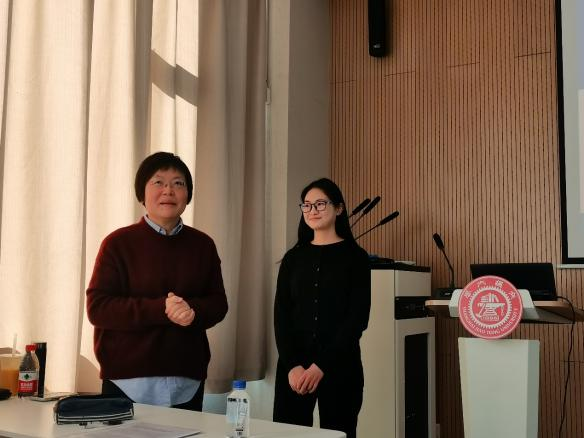
Student Fan Xinran and Professor Ding Hongwei systematically explored the decline mechanism of elderly people's ability to recognize emotional intonation through meta-analysis and empirical research. They found that the significant decline in the elderly's ability to recognize emotional intonation is due to the interaction of multiple factors, including age-related cognitive decline, decreased auditory sensitivity, and language structure characteristics. These findings provide important theoretical basis for understanding the neural mechanism of emotional intonation processing and for developing intervention strategies to promote the social interaction ability of the elderly.

Dr. Chen Juqiang presented a series of cross-language tone speech experiments based on the Perceptual Assimilation Model, exploring the influence of factors such as native language background, memory load, and speech variation on the perception of Thai tones by native speakers of Chinese and Vietnamese, providing empirical evidence for tone teaching.

Lai Xue Xian and Professor Wu FuYun, using event-related potentials (ERPs) technology, discovered that the inversion error in the noun structure after the Chinese word "ba" induced a smaller N400 and a larger P600, revealing that readers can detect the inversion error and make online corrections, providing new evidence for the "noise channel theory".
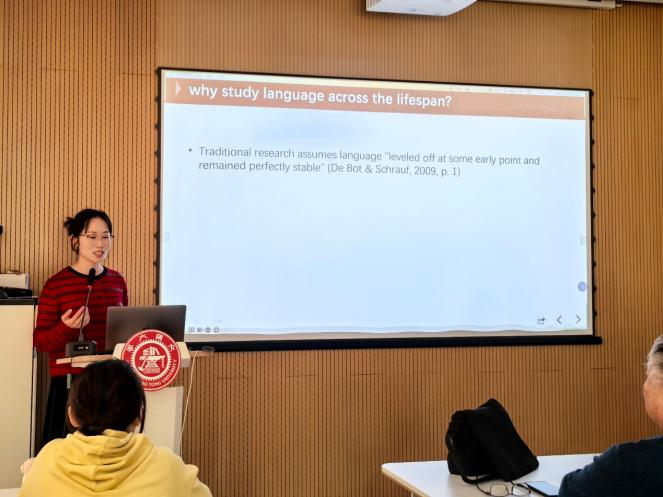
Zhaohuiwen and Associate Professor Huang Aijun used the Chinese version of the Multilingual Assessment Instrument for Narratives (MAIN) to systematically investigate the lifelong development of Chinese narrative ability, revealing the differentiated development trajectories of Chinese narrative ability throughout the entire life cycle. They also clarified the universal promoting effect of the retelling task on narrative performance at all ages, providing an important guiding direction for the framework of language assessment and intervention.
3. Applied Linguistics
Professor Yuan Boping raised key questions on the topic of "translanguaging": Should translanguaging be a teaching goal? Do bilingual/multilingual speakers have language boundaries? How does translanguaging theory explain the language mechanisms and grammatical rules shown in the corpus? These questions pose challenges to the notion of an unbounded and freely blended communicative resource pool advocated by translanguaging theory and point out directions for in-depth exploration for translanguaging scholars.

Dr. Sang Yuan, using the research method of intensive ethnography, discovered four major themes in the complex relationship between teacher identity and emotion: teacher identity triggers positive emotions, teacher identity triggers negative emotions, teacher emotions trigger identity development, and teacher emotions trigger identity conflicts. Dr. Sang Yuan constructed a conceptual model to reveal the interrelationship between teacher identity and emotion, providing practical evidence for exploring the theoretical connection between teacher identity and emotion and the professional development of pre-service teachers.

Professor Li Chengchen systematically reviewed the research on second language acquisition from the perspective of positive psychology from the 20th century to 2025, pointed out the deficiencies in the existing research in terms of research content, research methods, research design, and data analysis, and put forward corresponding improvement suggestions for future research.

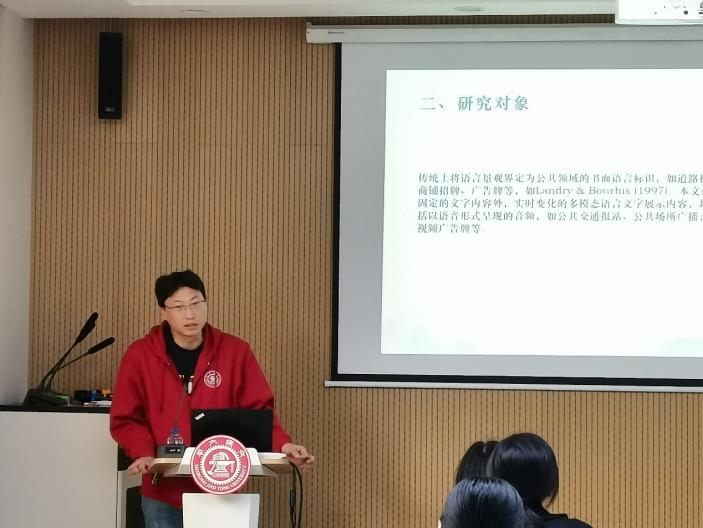
Based on field research and data collection in Seoul, Incheon and Gangwon Province of South Korea, Associate Professor Wang Pin has revealed the current characteristics of the Chinese language landscape in South Korea: Chinese expressions are often subordinate to Korean ones; the historical connection between Hanja and Korean pronunciation is often severed; the phonetic representation of Chinese proper nouns in Korean is inconsistent at times; and the excessive use of Korean has reduced the international communication effectiveness of the language landscape. Wang pointed out that the reasons for these phenomena are South Korea's linguistic nationalism and its tendency to break away from the influence of Chinese.
Dr. Cheng Haiting analyzed the behavioral data of Chinese learners on the Coursera platform and pointed out that test scores, the frequency of discussion participation, test duration and educational background have significant impacts on the learning persistence of Chinese online learneres in a non-target language environment. However, gender, the level of national development, employment status and the number of peer reviews have no significant influence. This provides data support for user retention strategies and teaching interventions in the digital transformation of international Chinese education.

4. Computational Linguistics
Liu Yikang and Dr. Hu Hai proposed the first continuous quantitative metric, T-index, which transforms the "translationese" from a binary classification task into a gradable assessment. They pointed out that T-index demonstrated strong generalization capabilities in both synthetic and real translation data, indicating that it can serve as an effective complement to existing translation evaluation methods.

Since its launch in 2021, the Linguistics Lunch Seminar has successfully held 95 sessions. It has evolved into an important platform for academic exchanges among the faculty and students of the school every Thursday noon, attracting the active participation of many scholars both within and outside the school. Here, research from different linguistic schools collide, and theoretical and empirical studies interweave to spark ideas, continuously injecting vitality and inspiration into the linguistic academic exploration.
More teachers and students are welcome to join the lunch meetings. Those interested in participating in the Spring 2026 Linguistics Lunch Seminar Series are welcome to send their application intentions via email to Professor Huang at the following address: ajhuang@sjtu.edu.cn.